



Table of Contents
Running an e commerce business in Mumbai today means fighting for space at every stage of growth. Our team at Vault.Rent works with online sellers across Andheri, Bandra, Lower Parel, and Powai every week, and the question we hear most often is simple. How do you store hundreds of SKUs without renting a full warehouse? India’s online retail market was worth close to 147 billion dollars in 2024, and small sellers make up the bulk of that growth. More than 1.5 million active sellers now run shops on major marketplaces, and most of them are small or medium businesses working with tight space and tighter budgets. Managing inventory for e commerce business owners has become a real operational challenge, not just a back-office task.
This guide draws on what we have learned from hundreds of Mumbai-based sellers who use Vault.Rent storage units to manage inventory, packaging, and seasonal stock. Follow these e commerce storage tips. By the end, you will know exactly how to organise 500 SKU units inside one standard 10×10 storage locker without losing track of a single product.
Why E Commerce Business Owners in Mumbai Choose Self-Storage Over Warehousing
A typical e commerce business does not need 2,000 square feet on day one. It needs flexibility. Self-storage gives sellers that flexibility without a long lease or a large upfront deposit. Recent market research found that 38 percent of online sellers earning under 500,000 dollars a year already keep their inventory in self-storage rather than a traditional warehouse. The reason is simple. Storage lockers in neighbourhoods like Goregaon, Thane, and BKC let sellers scale up before the festive season and scale down right after, without paying for space they are not using.
India’s self-storage sector itself is expanding fast, with industry estimates placing the market at around 2.2 billion dollars and projecting steady growth through the next decade. That growth is being driven largely by small businesses that need secure, organised space close to home or office, not a warehouse an hour away in an industrial belt.
Understanding Your 10×10 Storage Locker
A standard 10×10 storage locker gives you 100 square feet of floor space. On its own, that sounds small for 500 SKU units. But floor space is not the real constraint here. Most 10×10 lockers at Vault.Rent have ceiling heights of 8 to 10 feet. That gives you closer to 800 to 1,000 cubic feet of real storage space. You just need to build upward instead of outward.
Think of your locker as a small vertical warehouse rather than a flat room. Every shelf you add multiplies your storage capacity without adding a single square foot to your rent.
SKU Math: Fitting 500 SKUs into 100 Square Feet
Here is how the numbers actually work out for a typical e commerce business selling small to mid-sized items such as apparel, accessories, or beauty products. Good inventory e commerce planning starts with this kind of basic math, not guesswork.
- Install floor-to-ceiling shelving on three walls: This alone can give you 24 to 30 linear feet of shelf space.
- Use uniform storage bins, not loose boxes: A 12-by-12-inch bin holds 8 to 12 SKUs when items are folded or boxed individually.
- Reserve the centre aisle for packing and dispatch: Keep at least 24 inches clear so you can stand, pack, and scan orders without climbing over stock.
- Group SKUs by velocity, not by category: Your fastest-moving 50 to 80 SKUs should sit at waist height near the entrance. Slow movers go higher or deeper.
Following this layout, most sellers comfortably fit 500 to 600 SKU units into one 10×10 unit, with room left over for packaging supplies and a small work table.
Inventory Organisation: A Simple System That Actually Holds Up

Good inventory organisation is what separates a storage locker that works from one that turns into chaos within three months. Sellers who manage e commerce inventory well almost always rely on a three-layer system, not memory alone.
Zone mapping: Divide your locker into zones, such as Zone A for fast movers, Zone B for mid movers, and Zone C for slow movers or returns. Label every shelf clearly.
Bin level labelling: Every bin gets a code, not just a product name. A simple system like A1, A2, B1 lets any team member find a SKU in seconds, even if they did not pack it.
Digital backup: Pair your physical layout with inventory management software so your bin codes match your stock sheet exactly. When your software says SKU 214 is in bin B3, it should actually be there.
This kind of structured inventory organisation is one of the most overlooked storage tips for e commerce business owners. It is often the single biggest time saver during festive rush periods.
Practical Storage Solutions and Inventory Storage Solutions Beyond Shelving
A handful of practical storage solutions make a real difference once your shelving is in place. These small additions turn a bare locker into one of the more efficient inventory storage solutions available to small e commerce businesses.
- Clear bins for fast movers so you can see contents without opening every box.
- Vertical hanging rails for apparel sellers, which free up floor space compared to folded stock.
- Climate control for products sensitive to Mumbai’s humidity, including leather goods, cosmetics, and electronics accessories.
- A small dispatch table near the entrance so that packed orders never sit on the floor.
Benefits of a Storage Unit for E Commerce Business
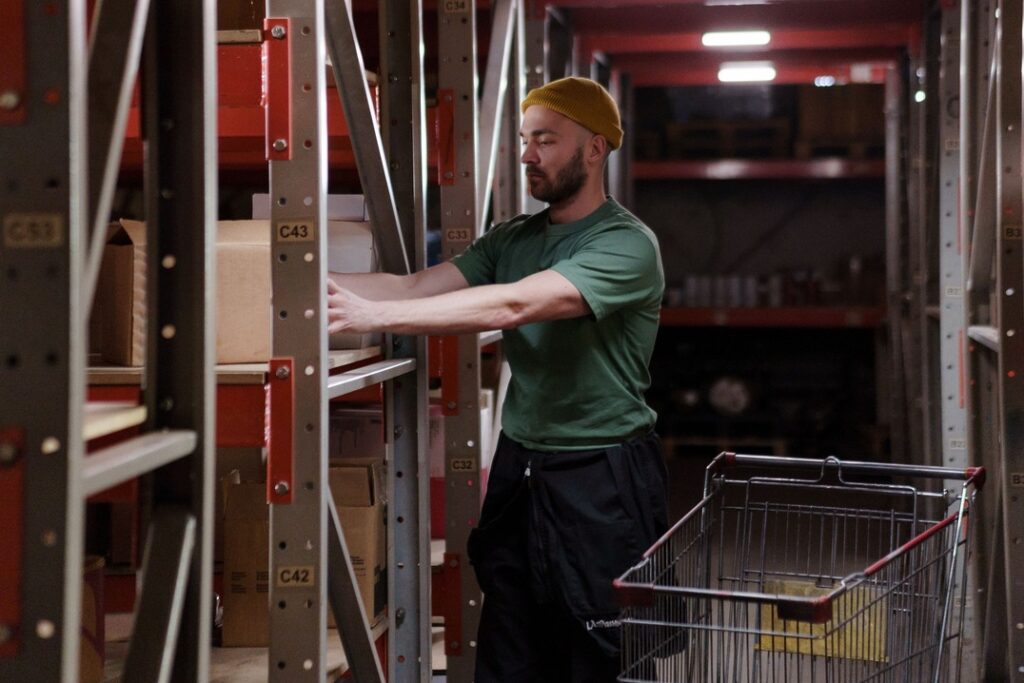
The benefits of a storage unit for an e commerce business go well beyond saving rent. A dedicated, lockable space keeps inventory separate from your home, which matters once you cross a few hundred SKUs. It also gives you a single, organised location for audits, restocks, and returns processing. Sellers who move out of a spare bedroom or balcony into a proper storage unit typically report fewer misplaced items and faster order packing within the first month.
For a growing e commerce business, a storage unit also acts as a buffer against unpredictable demand. Festive spikes, flash sales, and seasonal collections all need temporary extra space. A flexible storage rental lets you add a second unit for a few months. You avoid signing a year-long warehouse lease just to cover a busy quarter.
“We have watched sellers go from a cluttered spare room to a fully zoned 10×10 unit in under a week. Once the bin system is in place, the difference in how fast they pack and ship orders is obvious within days.“
Manish Kamti, Operations Lead at Vault.Rent
How an E Commerce Business Plan Should Account for Storage
Most first-time sellers leave storage out of their e commerce business plan entirely, treating it as an afterthought once stock starts piling up. A better approach is to budget for storage the same way you budget for packaging or shipping. As your e commerce business model matures, your storage needs change too. A single product idea often starts in a corner of your home. A growing catalogue needs a dedicated locker. A business with multiple categories may need two or three units during peak season. Planning for this shift early saves both money and panic later.
Sellers who plan this way avoid the most common early mistake we see, which is signing a large warehouse lease too early, then sitting on mostly space for months.
Quick Checklist Before You Rent a 10×10 Unit
Use this short checklist before you sign up for any storage unit:
- Count your current SKUs and add 20 percent for growth.
- Plan shelving on three walls, not just one.
- Choose uniform bin sizes so shelving stays standard.
- Pick a location near your packing hub, such as Andheri, Powai, or Lower Parel, to cut delivery time.
- Confirm climate control if you sell cosmetics, leather, or electronics accessories.
- Set up your inventory management software before moving a single box.
This small amount of planning saves hours of reorganising once your stock is already inside the unit.
Ready to organise your inventory the right way? Vault.Rent offers flexible 10×10 storage lockers across Mumbai, built for e commerce storage and for sellers who need secure, scalable space without a warehouse commitment.
FAQs
How many SKUs can fit in a 10×10 storage unit?
With proper vertical shelving and uniform bins, most e commerce businesses comfortably fit 500 to 600 SKU units in a single 10×10 storage locker.
Inventory e commerce store meaning: what does it actually include?
An inventory e commerce store holds more than finished products. It includes packaging materials, return stock, and items waiting for dispatch. Most sellers underestimate how much space packaging alone takes up.
Is self-storage cheaper than warehousing for a small e commerce business?
Yes, in most cases. For sellers with fewer than a few thousand SKUs, self-storage usually costs less than warehousing. There is no long-term lease to sign. There is no large security deposit. There is no minimum tenancy to commit to.
What inventory management software works well with a storage unit?
Cloud-based inventory management software works best, especially tools that support barcode or QR scanning. This way, your digital stock count always matches the physical bin codes in your storage unit.
Can I store e commerce inventory in a climate-controlled unit?
Yes. Climate-controlled storage units protect items sensitive to heat and humidity, such as cosmetics, leather goods, and electronics accessories, which matters for sellers across Mumbai’s coastal climate.