


Table of Contents
For decades, Mumbai’s small businesses have been held hostage by fixed warehouse leases- paying for space they don’t use, in months they don’t need it. A smarter model is reshaping that story: on-demand warehousing. Here’s why thousands of MSMEs are making the switch.
Picture this: You run a garment export business in Dharavi. The Diwali season approaches, and your inventory triples overnight. Your current 3,000 sq. ft. warehouse lease – signed at ₹85/sq. ft. – now feels laughably inadequate. You scramble to find temporary storage. By February, the rush dies down, and you’re paying for empty shelves until March, when the lease renews.
This isn’t a hypothetical. It’s the daily reality of over 7.5 lakh MSMEs in Mumbai, a city where warehouse rents rank among the highest in India. But a quiet revolution is underway—one that lets businesses pay only for the space they actually use, when they use it.
Welcome to the world of on-demand warehouse in Mumbai – and it could be the most important operational change your business makes this decade.
Hidden Cost Burden Mumbai’s MSMEs Rarely Talk About
Warehousing is rarely the first thing Mumbai entrepreneurs think about when budgeting. And that’s exactly the problem. According to IBEF’s logistics sector report, storage and warehousing costs account for 12–15% of total operating expenses for Indian MSMEs – a figure that balloons for businesses in high-rent cities like Mumbai, Pune, and Navi Mumbai.
Traditional warehouse leases lock businesses into:
- Fixed monthly rents regardless of inventory levels
- Long-term lease commitments (typically 3–5 years)
- Additional costs: security deposits (6–12 months), maintenance, insurance, staffing
- Penalties for early termination
- No flexibility during seasonal demand fluctuations
Why This Hits Mumbai MSMEs Hardest
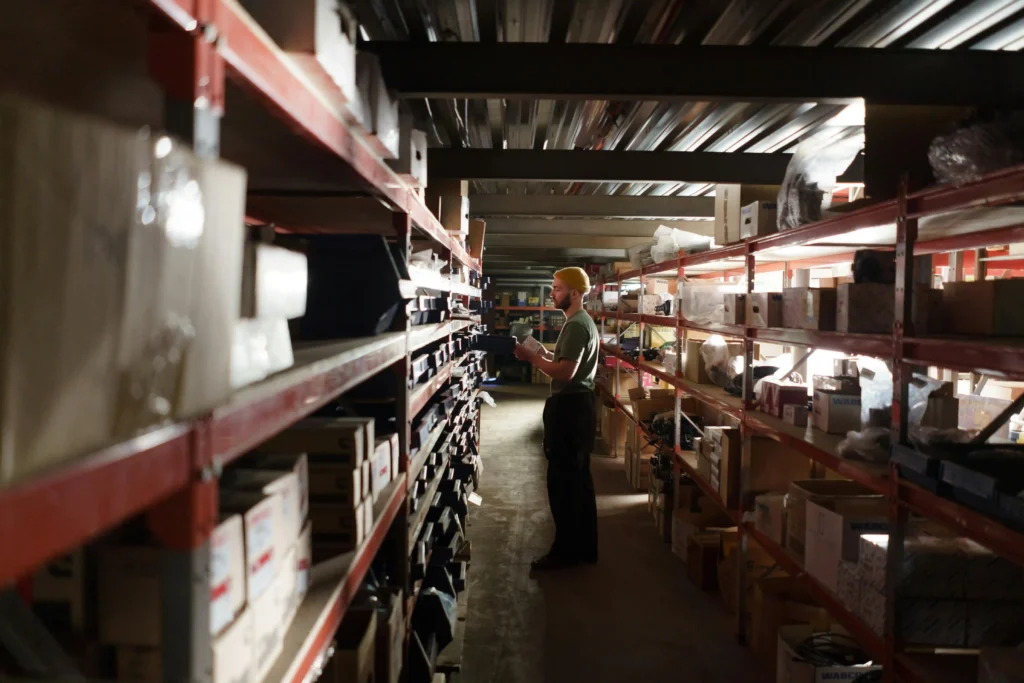
Mumbai’s geography amplifies the problem. With the city hemmed in by the sea on three sides, warehouse rental costs in Bhiwandi, Panvel, and Turbhe – Mumbai’s primary logistics corridors – have risen 22% in the last three years alone. Small businesses that can’t afford dedicated spaces near their supply chain are forced to either overcommit to expensive leases or absorb the operational chaos of distant, inconvenient storage.
What Exactly Is On-Demand Warehousing?
On-demand warehousing (also called pay-per-use storage, shared warehousing, or flexible warehousing) is a model where businesses rent storage space – and associated services – based on actual consumption rather than fixed allotments.
Instead of signing a lease for 2,000 sq. ft. for 36 months, you pay for:
- Pallets or bins stored – by count, not square footage
- Days or weeks used – not months or years
- Services consumed – pick-and-pack, dispatch, labelling – billed per order or per unit
Think of it as the difference between buying an airline seat versus chartering an entire plane. Most MSMEs don’t need a whole plane.
How Do MSMEs Actually Save 40%? A Real-World Breakdown
The 40% figure isn’t marketing hyperbole — it’s a byproduct of eliminating waste in a system designed for waste. Here’s how the math works for a typical Mumbai MSME:
| Cost Element | Traditional Lease | On-Demand Warehouse Model |
| Monthly space rent (2,000 sq ft) | ₹1,70,000 | ₹65,000–₹90,000 (usage-based) |
| Security deposit (upfront) | ₹10–₹20 lakh | ₹0 or minimal |
| Off-season months (4–5 months/year) | Full rent regardless | Pay for actual inventory only |
| Staffing (security, operations) | ₹40,000–₹60,000/month | Included in service fee |
| Scalability during peak season | Limited / costly | Instant, no renegotiation |
| Exit flexibility | Heavy penalties | 30-day notice or less |
When you factor in security deposit recovery, reduced off-season waste, and bundled operational services, the total cost of ownership under a pay-per-use model drops dramatically — typically between 30% and 45% for businesses with seasonal demand cycles, which describes the majority of Mumbai’s textile, food, electronics, and gift-ware MSMEs.
Which Mumbai MSMEs Benefit Most From Flexible Warehousing?
1. Seasonal Businesses (Textiles, Gifts, Festive Goods)
If your inventory spikes during Diwali, Eid, Christmas, or wedding season, you’re paying for dead space the rest of the year. Seasonal warehousing solutions for Mumbai businesses let you scale up in October and scale down in January — with no penalties and no waste
2. E-Commerce Sellers and D2C Brands
Mumbai’s booming D2C ecosystem — concentrated in areas like Malad, Goregaon, and Chembur — relies on fast fulfillment. E-commerce warehouse solutions Mumbai that combine on-demand warehouse storage with same-day pick-and-pack are increasingly preferred over self-managed spaces. You get Shiprocket-level speed without Shiprocket-level dependency.
3. Import-Export Businesses Near JNPT
Businesses working with Jawaharlal Nehru Port (India’s largest container port) often need short-term bonded or transit storage while clearing customs. Pay-per-use models near Nhava Sheva and Uran solve exactly this — no 12-month commitment for what might be a 10-day storage need.
4. Manufacturers in Bhiwandi & Thane Industrial Belt
For manufacturers managing raw material buffers and finished goods simultaneously, multi-location flexible warehousing in the MMR (Mumbai Metropolitan Region) enables lean inventory management without capital blockage in deposits.
How to Make the Switch: A Step-by-Step Guide for Mumbai MSMEs

Transitioning to an on-demand warehousing model doesn’t require a supply chain overhaul. Here’s a practical roadmap:
Audit Your Current Warehousing Costs
Calculate your true cost: base rent + deposit opportunity cost + utilities + staffing + idle space months. Most businesses are shocked by this number.
Map Your Demand Seasonality
Identify your peak and off-peak months. A business with a 4-month peak and 8-month trough has far more to gain than one with consistent throughput year-round.
Define Your Service Requirements
Do you need just storage? Or also picking, packing, labelling, returns management, or temperature control?
Third-party logistics (3PL) warehousing in Mumbai providers offer varying service bundles.
Compare On-demand warehouse Providers in Mumbai
Evaluate providers on location (proximity to JNPT, western suburbs, Thane), pricing transparency, WMS (Warehouse Management System) technology, and contract flexibility. Look for ‘no minimum commitment warehousing in Mumbai‘ offers.
Run a Pilot Before Full Transition
Move 20–30% of your inventory to the new model for two months. Measure cost, fulfillment speed, and operational quality before committing fully.
Renegotiate or Exit Your Existing Lease
Many landlords will negotiate early exits- especially post-COVID, when vacancy rates in Bhiwandi have risen. Legal advice is recommended before triggering exit clauses.
5 Myths Mumbai Business Owners Believe About On-Demand Warehousing
Myth #1: “It’s only for large businesses.”
Reality: On-demand warehouses are specifically designed for MSMEs. Many providers in Mumbai accept bookings as small as 10 pallets or 500 sq. ft. – with no long-term contract.
Myth #2: “I’ll lose control of my inventory.”
Reality: Modern cloud-based WMS platforms give you real-time visibility of every SKU, every pallet, every dispatch – often better visibility than a self-managed warehouse.
Myth #3: “It’s more expensive per square foot.”
Reality: Yes, the rate per sq. ft. may be higher. But the total cost—including deposit, staffing, idle months, and overhead- is consistently lower. Compare TCO, not unit rates.
Myth #4: “Shared warehouses aren’t secure.”
Reality: Reputable shared warehousing facilities in Bhiwandi and Navi Mumbai operate under ISO standards with CCTV, access controls, and item-level insurance.
Myth #5: “It won’t work for my product type.”
Reality: On-demand warehouse providers in Mumbai now offer temperature-controlled storage Mumbai, hazmat-compliant zones, fashion garment areas, electronics-safe environments, and bulk commodity bins.
Future of MSME Warehousing in Mumbai: Where Is This Heading?
The trend lines are clear. As per NITI Aayog’s logistics roadmap, India’s warehousing sector is expected to grow at 10.5% CAGR through 2027, with shared and tech-enabled warehousing capturing an increasing share of that growth.
For Mumbai MSMEs specifically, several forces are accelerating the shift:
MSME government schemes: Initiatives like the MSME Ministry’s logistics support program are increasingly recognizing flexible warehousing as an eligible business expense for subsidies.
Infrastructure upgrades: The Mumbai Trans-Harbour Link and Navi Mumbai Metro are improving access to previously underserved warehousing zones, expanding viable locations.
Automation integration: On-demand warehouse storage providers are investing in robotics and automated sortation – services that individual MSMEs could never afford to deploy on their own.
App-based booking: On-demand warehouse booking apps in India are making it as easy to reserve storage space as booking a hotel room, with hourly or daily commitments becoming available.
What to Look for When Choosing an On-Demand Warehouse in Mumbai?
Not all flexible warehousing providers are created equal. When evaluating cost-effective warehousing options for small businesses in Mumbai, use this checklist:
- ✅ Location alignment: Is the facility close to your customers, suppliers, or port? Bhiwandi suits western-corridor businesses; Panvel/Uran for JNPT proximity; Turbhe or Taloja for Thane-belt manufacturers.
- ✅ Pricing transparency: Is the quote all-inclusive or does it hide handling, fuel, and technology charges?
- ✅ WMS access: Can you track inventory in real time? Do you get dispatch alerts and SKU-level reports?
- ✅ Scalability terms: How quickly can you scale up (for peak season) or down (for off-season)?
- ✅ Insurance coverage: Is your inventory insured against fire, theft, and water damage?
- ✅ Exit clause: What notice period is required? Are there penalties?
- ✅ Value-added services: Kitting, labelling, returns management, GST-compliant dispatch documentation?
40% Is Real- But It’s Just the Beginning
The shift to on-demand warehouse models in Mumbai isn’t merely a cost-saving tactic. It’s a fundamental reimagining of how small businesses in Mumbai think about capital, agility, and growth.
When you free up the ₹10–₹20 lakh security deposit. When you stop bleeding rent during your slowest months. When your operations team focuses on sales and product instead of warehouse management, you don’t just save 40%. You redeploy that capital into inventory, marketing, and people. That’s where real growth happens.
Mumbai’s MSMEs built this city’s economy on hustle and adaptability. On-demand warehousing is simply the infrastructure catching up to match that energy.
Optimizing MSME Logistics with Vault.rent
Vault.rent empowers Mumbai’s MSMEs by replacing rigid, high-cost traditional leases with flexible, on-demand warehousing. This tech-enabled approach streamlines inventory management and order fulfillment, allowing businesses to scale seamlessly during peak seasons without the burden of empty space. By integrating professional security and doorstep logistics, it enables smaller brands to achieve enterprise-level efficiency and faster delivery times.
Ready to see how much your business could save?
Get a free warehousing cost audit for your Mumbai MSME – no commitment, no sales pressure. Just real numbers for your specific business.
FAQs
Which is the warehouse capital of India?
Bhiwandi is the largest warehousing hub of India.
What is the future of warehousing?
Future warehouses rely on automation and digital integration to streamline workflows. Advanced tracking and retrieval technologies won’t just improve accuracy; they’ll shift the human workforce away from repetitive labour and toward higher-level tasks
How many warehouses are there in India?
As per the data, there are a about 35252 warehouses in India as of October 15, 2025.
Who is the father of warehousing?
Bill Inmon is the father of warehousing
What are the 7s of warehousing?
By integrating the seven core pillars- Sorting, Setting in Order, Shining, Standardizing, Sustaining, Safety, and Spirit-this framework drives waste elimination and continuous improvement. The result is a workplace that is not only more efficient but also safer and more culturally aligned.
What are the smart objectives for a warehouse?
Storage Optimization: Strategically arranging inventory to maximize warehouse footprint and streamline retrieval speeds.
Inventory Control: Balancing stock levels through precise record-keeping to satisfy market demand while minimizing carrying costs and stockouts.
Order Execution: Orchestrating the end-to-end picking, packing, and distribution process to ensure reliable, high-speed delivery to the end consumer.
Can e-commerce sellers use on-demandwarehousing?
Indeed; it optimizes inventory control, accelerates distribution cycles, and provides the necessary elasticity to handle peak seasonal demands.